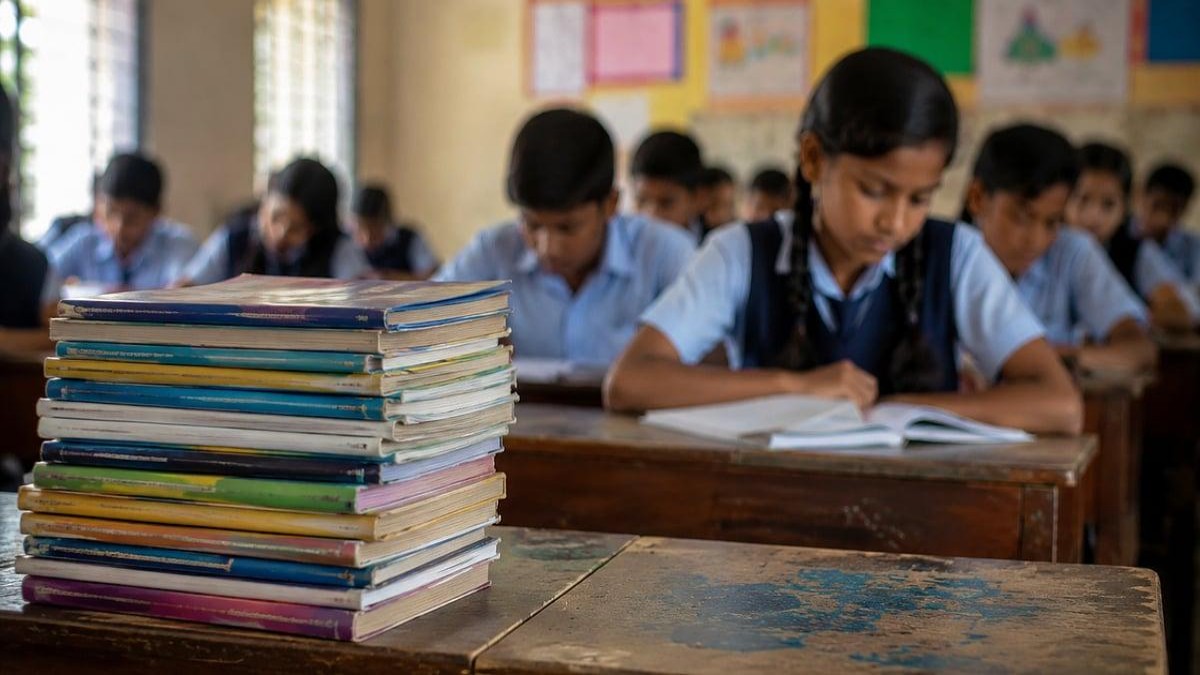
In a sweeping push to elevate foundational learning standards and ensure zero academic interruption, the government education machinery has rolled out an expansive publication plan ahead of the upcoming academic year. Under this strategic framework, students enrolled in primary and upper primary tiers across public and state-aided institutions will receive brand-new learning resources right from the onset of the instructional term. The Department of School Education and Literacy has sanctioned the printing of over twenty million individual textbooks and interactive activity workbooks for grades one through eight, backed by an estimated expenditure exceeding one hundred and thirty-five crore rupees. This far-reaching intervention guarantees that every enrolled child enters the classroom fully equipped from day one.
The distribution blueprint spans every corner of the state across all twenty-four administrative territories, relying on an organized supply-chain network designed to wipe out the traditional delays that historically disrupted early term lessons. Foundational stage pupils in grades one and two will receive comprehensive sets containing core subject readers alongside dedicated practice workbooks designed to build fundamental literacy and numeracy. Meanwhile, students advancing through grades three up to eight are slated to receive thorough, subject-specific textbooks encompassing their entire mandatory curriculum. Following publication, these massive consignments will be transported to designated cluster resource hubs at the sub-district level before making their way directly to school campuses for completely cost-free dispersal to every eligible child.Budget allocations indicate that upper primary schooling represents the largest single share of this publishing commitment. The government has planned the production of nearly thirty-four lakh units for grade six, over thirty-three lakh volumes for grade seven, and more than thirty-five lakh books dedicated to grade eight.
Financially, grade eight leads the program with an estimated fiscal envelope surpassing twenty-one crore rupees, while grades six and seven have each been allocated approximately twenty crore rupees to cover extensive publishing and logistics requirements. Foundational classrooms also retain significant volume, with over twenty-one lakh copies designated for grade one and nearly twenty-two lakh units printed for grade two to support early learners across foundational classrooms.
Beyond public school campuses, this welfare scheme incorporates an innovative distribution mechanism that benefits private institutions that adhere to the official state curriculum framework. Privately managed academies that use state-mandated syllabi will now have seamless access to genuine instructional materials through open-market commercial networks. Authorities have permitted registered vendors to stock and sell these verified educational prints at the baseline rate plus an approved twenty percent vendor markup. This provision eliminates previous supply bottlenecks for self-financed institutions, shielding guardians and private school pupils from artificial shortages, counterfeit material, or exorbitant market price gouging.
To prevent physical wear and preserve book longevity throughout the school calendar, strict technical manufacturing benchmarks have been established for paper consistency and binder durability. Textbooks and practice modules meant for grades one and two must feature robust eighty grams per square meter interior sheets paired with thick two hundred and twenty grams per square meter cover pages. Intermediate and upper primary reading material across grades three to eight will utilize standardized seventy grams per square meter paper stock with resilient one hundred and seventy grams per square meter outer binding. Every page must bear the authentic, certified watermark of its producing paper mill, while the application of brittle recycled pulps or inferior scrap material has been outlawed under enforceable penalties, with mandatory state laboratory inspections preceding batch acceptance.
Regional procurement trends show that Giridih records the highest requirement among all territories, calling for nearly three lakh comprehensive textbook sets to cater to its expansive school-going demographic. Palamu follows closely behind with an assessed requirement of two point seven lakh packages, while West Singhbhum demands over two lakh sets. Substantial consignments are also scheduled for Deoghar, Sahibganj, and Godda, culminating in a cumulative state target exceeding thirty-three lakh complete instructional sets delivered across all municipal jurisdictions. Through tight production oversight and structured dispatch mechanisms, the state intends to ensure seamless classroom engagement from the first bell of the new academic calendar.
About The Author